


“We See Now Through a Mirror in an Obscure Manner”

Fr. Scott Haynes
A Shrove Tuesday Meditation
A Shrove Tuesday Meditation
Saint Paul tells us,
“We see now through a mirror in an obscure manner, but then face to face.”
These words describe the whole of our earthly life. We know God, but imperfectly. We love Him, but not yet with a pure heart. We walk in faith, not yet in vision.
How fitting that these words echo on the eve of Lent.
Shrove Tuesday has always been a day of clearing the mirror. The word “shrove” comes from to shrive, meaning to confess. It was the day when Christians examined their consciences, confessed their sins, and prepared their souls for the great journey of Lent.
Why confession? Because sin clouds the mirror.
When pride, anger, impurity, or resentment settle in the heart, the soul’s vision grows dim. We begin to see God poorly. We misunderstand His will. We lose the sense of His presence. It is not that God has moved away from us. It is that the mirror of the heart has grown tarnished.
Shrove Tuesday is the day the Church invites us to polish that mirror.
A powerful example of this is found in the life of Saint Margaret of Cortona.
As a young woman, Margaret was beautiful, lively, and full of passion. But after the death of her mother, she drifted from a life of virtue. She entered into a sinful relationship with a nobleman and lived with him for many years. She bore him a child. Outwardly, her life seemed comfortable and secure. She enjoyed fine clothing, pleasant surroundings, and the admiration of others.
But the mirror of her soul was dim.
Then came the day everything changed.
Her lover did not return home. His dog came back alone, restless and insistent. Tugging at her garments, it pulled her toward the woods. When she followed, she found the man’s body lying in a ditch, murdered and abandoned. The shock pierced her heart. In that terrible sight, the illusions of her life collapsed. She saw not only his death, but her own soul. She saw how fragile life was, how empty her pleasures had been, and how close she stood to eternal loss.
It was as if the mirror had suddenly been held up before her.
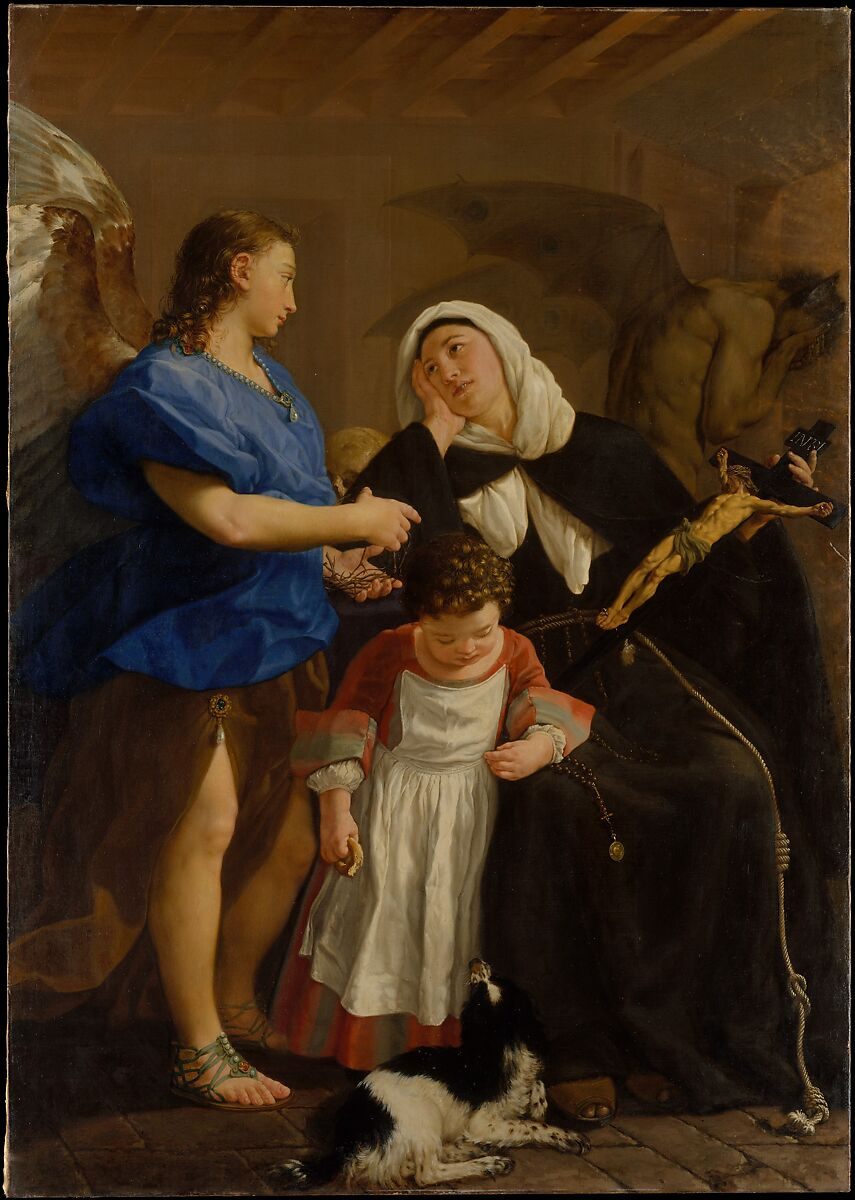
An Italian painter, Gaspare Traversi, working around 1758, captured this moment of conversion in a striking image. Traversi was known for lively scenes of everyday Italian life, but here he turned to the story of this thirteenth-century penitent. In his painting, the young child stands in the foreground beside the faithful dog that led Margaret to the dreadful discovery. Behind them, Satan retreats in defeat, slipping back into the shadows. The devil represents her former life—the illusions, the pleasures, the sins that once clouded her soul. Now, exposed by the light of truth, he withdraws.
The mirror had begun to clear.
Margaret fled that life. She returned to her father’s house and begged forgiveness. Though she was received coldly, she did not turn back. She went to Cortona, confessed her sins with deep sorrow, and began a life of prayer, penance, and charity.
She embraced poverty. She fasted. She cared for the sick and the poor. She spent long hours in prayer before the crucifix. The woman who once sought admiration now sought only the face of Christ.
Yet even in her holiness, she knew she still lived by faith. She did not yet see God face to face. She still walked in the obscurity of this life, longing for the day when the mirror would be taken away.
Her conversion began with a moment of painful clarity, but her sanctity grew through years of patient purification. Her life became a living Lent.
And that is what Lent is meant to be for us.
Prayer clears the mind.
Fasting disciplines the senses.
Almsgiving purifies the heart.
These practices do not earn heaven. They simply remove what obscures our vision. They help the soul become more transparent to God.
Shrove Tuesday stands at that threshold. It asks a simple question:
What in my life is clouding the mirror?
Is it an old resentment? A hidden sin? A habit that dulls the soul? A distraction that keeps me from prayer?
Tonight, the Church gently invites us to clear the surface of the heart, so that during Lent the light of Christ may reflect more clearly within us.
For now, we still see in an obscure manner. But every confession, every sacrifice, every act of love brings us closer to the day when the mirror will no longer be needed.
Then, at last, we shall see Him face to face.


Comments