


St. Edmund Campion and the Sacred Mission of Catholic Media
Updated: May 17
Fr. Scott Haynes
A Meditation for the Sunday after the Ascension
World Communications Sunday
During the English Reformation, a priest of the Church of England, Edmund Campion, reached great importance in the Anglican Church. When he took the Oath of Supremacy in 1564, he rejected
his Catholic faith, the role of Supreme Pontiff to govern the Church, and embraced the Church of England headed by Queen Elizabeth I. For twelve years, he was away from communion with the Catholic Church, during which time he was ordained a deacon in the Anglican Church.
In 1566, as an Anglican deacon, he preached before Queen Elizabeth I at the University Church of St. Mary the Virgin in Oxford. By the time the Queen had left Oxford, Campion had earned the patronage of the powerful William Cecil and also Robert Dudley, the Earl of Leicester, tipped by some to be future husband of the young Queen.
But fifteen years later, a myriad of things had changed.[1] Campion was no longer one of Queen Elizabeth’s favorites, because, in 1571, he fled to Douai in France, in order to be reconciled to the Roman Catholic Church and was readmitted to full communion. Not only that, Campion went to Rome and became a Jesuit and was ordained a Catholic priest. Returning to England in 1580, he led a hunted life, preaching and ministering the sacraments to Catholics in Berkshire, Oxfordshire, Northamptonshire, and Lancashire.

In 1581, Father Campion then wrote a Latin treatise, Decem Rationes,[2] or “The Ten Reasons,” in which he defended the Catholic faith and challenged his Anglican compatriots to debate with him. This was an extremely dangerous time to live as a priest in England, and to publish such an work in the intense religious and political atmosphere of 16th century England was at the very least inflammatory.
Because of the 1558 Recusancy Acts, to say Mass, to preach, to hear confessions and administer sacraments was against the Queen’s law.[3] So, Father Edmund Campion’s Decem Rationes were a bold affront to the Queen and her government—a proclamation that the Catholic faith was here to stay.

When the manuscript was finished, he found it extremely difficult to get this work printed. Eventually the work was carried out on a secret press at the house of Dame Cecilia Stonor in Stonor Park, Berkshire. Lady Stonor was later to die in prison for her part in this enterprise. Owing to a shortage of type, the treatise had to be set one page at a time, and it took half a dozen typesetters nine weeks to set it.
On Commemoration Sunday, June 27th 1581, 400 copies were found distributed on the benches of the Anglican University Church in Oxford, the same church Fr. Edmund Campion had formerly preached to Queen Elizabeth when he was an Anglican deacon, and the same church in which John Henry Newman in the 19th century would preach prior to his conversion to the Catholic Church.
Fr. Edmund Campion and a few friends quietly came into the church early before anyone else was awake and there they placed the Catholic propaganda all over the University Church. The publication of Decem Rationes caused a tremendous sensation all over England, and it became a national effort to capture Campion and kill him.[4]

The story of Edmund Campion shows us, first of all, that a Christian who wants to witness to his or her faith beyond his or her immediate circle of family and friends will often use some sort of media. It usually begins with simple things. We can send email to friends about spiritual topics, share a good book on the spiritual life with a neighbor, gift someone with a Rosary, or put a prayer card in letters and bills when mailing them out. I suppose if St Edmund Campion were here today, he would cover the town with books and pamphlets to help teach the Catholic faith, putting them on the pews of every non-Catholic church, in the subway, in the doctor’s office—everywhere.
Like St. Edmund Campion, we should use the media passionately. With zeal and charisma, he wanted to spread the truth of the Gospel. For Campion, this meant the printing press. In our own times, it has meant not only print media, but also TV, radio, the Internet, CDs and DVDs.

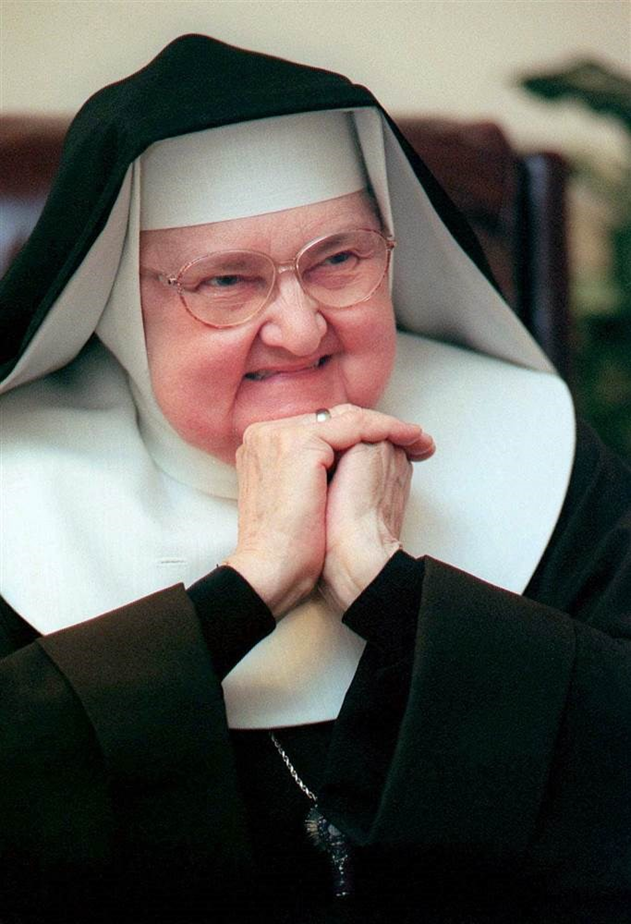
The most important pioneer today in Catholic media is Mother Angelica. It seems rather odd that nuns would be the ones to start up a religious TV network. Mother Angelica agreed, stating: “Cloistered nuns on television are without doubt the most ridiculous things that could happen. It just evolved.” Sometimes, it seems God calls unlikely candidates to do His work.[5] Sometimes it seems we have inspirations from the Holy Spirit to share the Gospel with our neighbor, but we hold back. Is it our pride? Are we afraid? Mother Angelica once remarked: “I am not afraid to fail, [but] I am scared to death of dying and having the Lord say to me. ‘Angelica, this is what you might have done had you trust me more.’”

So when the Lord lit a fire underneath her to start up a Catholic TV stations, Mother Angelica needed a TV studio to get it going. She did not start with anything luxurious. She started with a small garage at the monastery and transformed it into their first TV studio, which is still used today. At the beginning, the sisters did everything. They operated the cameras, did the lighting— everything from soup to nuts. But, in order to broadcast television, she needed enormous satellite dishes, and the cost was six hundred thousand dollars. There was a slight hindrance – Mother Angelica only had two hundred dollars.
Mother Angelica, who is of Italian blood, began looking for an Italian satellite dish provider, because she knew how to negotiate with one of her own. Having found one satellite dish retailer in Atlanta, Mother Angelica began bargaining. “The dish will cost six hundred thousand dollars,” he told her. “Well, what if I pay you a little now, and more money as time goes on,” Mother Angelica said. “That’s not how we do business,” he said plainly. “That’s because you lack faith,” Mother Angelica gently admonished him. The conversation ended with him saying, “not one piece of equipment will come off the truck unless you have all the money to pay for it.”

On the day of delivery, two trucks with satellite dishes pulled up outside Mother’s monastery, Our Lady of the Angels Monastery in Irondale, Alabama. Mother Angelica decided to show them the monastery–an effort to stall them because she didn’t have a penny. She told them to wait while she went into the chapel to pray. Kneeling down in the pew she said to the Lord, “well, your delivery is outside. It’s your satellite. You’ve got to go and pay the man now. He wants six hundred thousand dollars and I don’t have it.”
Reconciling herself to the fact that six hundred thousand dollars was not going to tumble from the sky, and questioning if the satellite dishes were really God’s plan, Mother Angelica went back out to the delivery man, and told him that she had no money. But just then, at that exact moment, one of the sisters rushed up to her, “‘Mother, there has been a man calling and calling on the phone and he won’t stop until he talks to you. This man says it’s an emergency!”
A little bit reluctantly, Mother Angelica picked up the phone, and the caller was a wealthy businessman who was calling from his yacht in the Bahamas. He had been very moved after reading one of Mother’s pamphlets on suffering and family life. The businessman had got embroiled in a life of drugs. Though he was rich and lacked no earthly comfort, he was terribly unhappy.
The man was ready to commit suicide and end it all. He went to a restaurant and into the bathroom stall and was contemplating suicide but on top of the toilet was a little pamphlet by Mother Angelica. How did it get there? (Perhaps someone like St. Edmund Campion miraculously put it there). The man picked it up and started reading. And in reading Mother Angelica’s little booklet he found the Christian counsel he needed to make him stop drug-taking and reunite with his wife and kids. The Good News of Christ that Mother Angelica shared touched the man’s heart.
As he came out of the bathroom, he called the number of the Monastery on the back of the pamphlet. He wanted to thank her for the spiritual encouragement and for saving his life. As he spoke to Mother on the phone his heart was moved to show God thanksgiving. Out of the blue, as a token of his gratitude, he told Mother that he wanted to donate a sum of six hundred thousand dollars.
As you see, nothing is impossible with God. What trust we need to place in the good Lord, for He takes care of His own. Once Mother Angelica explained the situation to the man and he wired the money right away. Those satellite dishes, to this day, transmits EWTN to most of North America and most of Latin America.
In these days after the Ascension of our Lord we recall that Christ has given the Church the great commission to baptize, to preach and spread the Gospel to the four corners of the globe. Let us follow the example and zeal of St. Edmund Campion who preached fidelity to Christ and Church in the face of death, and having the courage of Mother Angelica to trust God and ask His blessing over our little efforts to spread the Gospel.
And just as St. Edmund Campion was persecuted so are we exhorted to suffer in union with Jesus as we spread the one true Faith. This is what Mother Angelica did and what I dare say, she is still doing from the confinement of her bed. When St. Edmund Campion was sentenced to death as a traitor, Queen Elizabeth believed she was doing a service to the people God, establishing her own Church of England free from the control of the Pope—liberating them from Rome. The Gospel described this scenario well today: “Yea, the hour cometh, that whomsoever killeth you will think that he doth a service to God.”[6]
St. Edmund Campion was a faithful preacher to Queen Elisabeth. He would not lie to her. He clearly explained the import of her decision to martyr him and his companions: “In condemning us, you condemn all your own ancestors, all our ancient bishops and kings, all that was once the glory of England—the island of saints, and the most devoted child of the See of Peter.”
In the Epistle of 1st Peter today, we read, “If any man speak, let him speak as the words of God…that in all things God may be honored through Jesus Christ, our Lord.”[7] St. Edmund Campion realized this perfectly in his life, especially at the final scene of his life. At hearing his death sentence, he and his companions broke out into song—they sang the Te Deum laudamus.

In the short 41 years of his life, and now in his death, St. Edmund honored Christ and gave thanks even for this. In his death St Edmund condemned no person but remembered that wisdom that we have from today’s Epistle—“charity covereth a multitude of sins.”[8]
Dear Friends in Christ, what have we done to spread the Gospel? We may not have the zeal of St. Edmund Campion or the boldness of Mother Angelica but, according to our own personality and temperament, God is inspiring each of us to spread the Gospel, to show the world Jesus Christ. As Pentecost now comes next Sunday, let us pray for the strength of the Holy Ghost to strive for the salvation of all and to be tireless apostles of the faith. Amen.

English Jesuit, St. Edmund Campion (1540-1581), standing on the scaffold, awaiting martyrdom for alleged conspiracy to overthrow Queen Elizabeth I, December 1, 1581, spoke these words:
“Spectaculum facti sumus Deo, angelis et hominibus. These are the words of St. Paul, Englished thus,
‘We are made a spectacle unto God, unto His angels and unto men,’ verified this day in me, who are here a spectacle unto my Lord God, a spectacle unto His angels and unto you men.”
Notes
1 By 1570, Queen Elizabeth was excommunicated by Pope St. Pius V in a papal bull, Regnans in Excelsis.
2 Decem Rationes gave arguments to prove the truth of Catholicism and the falsity of the Church of England.
3 O’Malley, John W., Early Modern Catholicism (Toronto: University of Toronto Press, 2001), 149.
4 Butler’s Lives of the Saints, New Full Edition, Liturgical Press, 2000, 12:3.
5 “But the foolish things of the world hath God chosen, that he may confound the wise; and the weak things of the world hath God chosen, that he may confound the strong” (1 Corinthians 1:27).
6 John 16:2.
7 1 Peter 4:11.
8 1 Peter 4:8.
Priestly Press




Comments