


Saint Marina: A Witness Against Religious Pluralism
Fr. Scott Haynes
Feast of Saint Marina of Antioch
July 20

Saint Marina (Saint Margaret of Antioch) lived in an age remarkably similar to our own. The Roman Empire welcomed many religions. Citizens could worship a multitude of gods so long as they also honored the emperor and accepted the religious system of the empire. Christianity alone stood apart because Christians proclaimed that Jesus Christ is not merely one god among many but the eternal Son of God, the only Savior of the world.
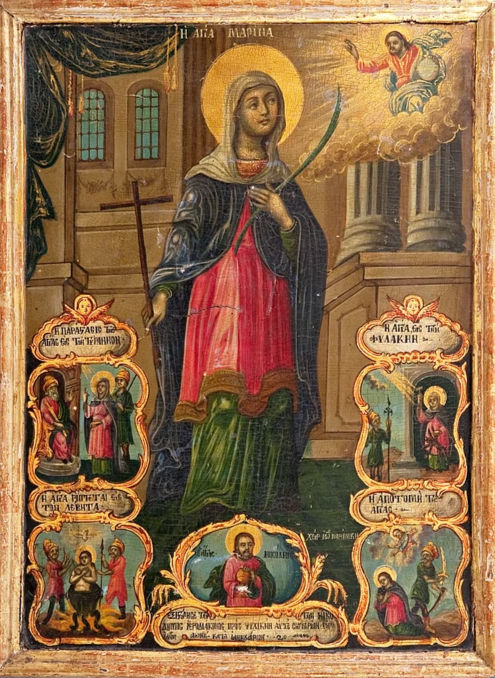
Saint Marina could have chosen the easier path. She could have treated Christ as one religious teacher among many or offered a token sacrifice to the pagan gods while privately keeping her Christian faith. Such a compromise would almost certainly have spared her imprisonment, torture, and death. Instead, she chose fidelity. She believed the words of Christ:
"I am the way, and the truth, and the life. No man cometh to the Father, but by me" (John 14:6).
To deny that truth would have been to deny Christ Himself.
The temptation facing Christians today is often more subtle but no less dangerous. Our culture applauds religious pluralism, urging us to regard every religion as an equally valid path to God. Even within Christian circles, one occasionally hears language that speaks of non-Christian religions or their places of worship in terms that can obscure the unique revelation entrusted to the Church or lessen the urgency of proclaiming the Gospel. Respect for every human person and recognition of elements of truth found in other religions should never lead us to forget that the fullness of divine revelation is found in Jesus Christ and that the Church He founded possesses the fullness of the means of salvation.

Saint Marina's witness stands as a powerful corrective to such confusion. She did not suffer because she believed religion was important. She suffered because she refused to place Christ alongside the pagan gods as merely one option among many. She willingly endured torture rather than offer even the smallest act of worship to a false religion. Her martyrdom proclaims across the centuries that truth is not negotiable and that fidelity to Christ sometimes requires heroic sacrifice.
This does not mean Christians should despise or hate those of other religions. Saint Marina herself undoubtedly prayed for her persecutors. Authentic charity, however, is inseparable from truth. To love another person is to desire that he come to know Jesus Christ, who alone conquered sin and death. If every religion were equally true, the Incarnation would have been unnecessary, Calvary would have been emptied of its meaning, and the blood of the martyrs would have been shed in vain.

The dragon that confronted Saint Marina also serves as a fitting image of the spiritual battle in every age. Satan delights in blurring the distinction between truth and error, persuading men that doctrine matters little so long as they are sincere. Yet Christ never spoke in such terms. He founded one Church, entrusted to her the Gospel, and commanded His disciples to "teach ye all nations" (Matthew 28:19), not simply to admire the religions of the world.
Saint Marina overcame the dragon by making the Sign of the Cross and remaining steadfast in Christ. Modern Christians are called to the same fidelity. We should treat every person with kindness and respect, defend the dignity of every human being, and seek peaceful dialogue whenever possible. At the same time, we must never surrender the truth that Jesus Christ alone is "the King of kings and Lord of lords" (Apocalypse 19:16). The saints did not die for a vague belief in religion. They died for Jesus Christ.
The witness of Saint Marina reminds us that every generation must choose between the approval of the world and fidelity to the Gospel. Her courage challenges us to know our faith, profess it without embarrassment, and live it with humility, conviction, and love. In an age tempted to blur the boundaries between truth and error, her life shines as a joyful and fearless testimony that Christ alone is worthy of our worship and that no earthly acceptance can compare with the eternal crown promised to those who remain faithful to Him.
Bibliography
—Butler, Alban. The Lives of the Fathers, Martyrs, and Other Principal Saints. Revised by Herbert Thurston and Donald Attwater. Westminster, MD: Christian Classics, various editions. See "St. Margaret (Marina) of Antioch."
—Catechism of the Council of Trent. Translated by John A. McHugh and Charles J. Callan. Rockford, IL: TAN Books, 1982.
—Delehaye, Hippolyte. The Legends of the Saints. Translated by Virginia M. Crawford. Notre Dame, IN: University of Notre Dame Press, 1962.
—Holweck, Frederick George. A Biographical Dictionary of the Saints. St. Louis: B. Herder Book Co., 1924.
—Jacobus de Voragine. The Golden Legend: Readings on the Saints. Translated by William Granger Ryan. 2 vols. Princeton, NJ: Princeton University Press, 1993.
—Pope Leo XIII. Satis Cognitum. 1896.
—Pope Pius XI. Mortalium Animos. 1928.
—The Roman Martyrology. Baltimore: John Murphy Company, 1916.
—The Synaxarion: The Lives of the Saints of the Orthodox Church. Compiled by Hieromonk Makarios of Simonos Petra. Translated from the French. Holy Convent of the Annunciation of Our Lady, Ormylia, Greece.
—Dominus Iesus. Vatican City: Congregation for the Doctrine of the Faith, 2000.
Online Resources
—New Advent. "St. Margaret (Marina)." Catholic Encyclopedia. https://www.newadvent.org/cathen/09767a.htm
—Orthodox Church in America. "Great Martyr Marina (Margaret) of Antioch." https://www.oca.org/saints/lives/2026/07/17/102047-greatmartyr-marina-margaret-of-antioch
—Greek Orthodox Archdiocese of America. "Great Martyr Marina." https://www.goarch.org/chapel/saints
—Catholic Online. "Saint Margaret of Antioch." https://www.catholic.org/saints/saint.php?saint_id=583


Comments