


Journey to Compostela: Walking the Road of Saint James
Fr. Scott Haynes
For the Feast of St. James
July 25

For more than a thousand years, Christians have set out on one of the world's greatest pilgrimages: the journey to Santiago de Compostela, where tradition holds that the relics of Saint James the Greater rest. Kings and peasants, saints and sinners, scholars and laborers have walked these ancient paths seeking forgiveness, renewal, and a closer friendship with Jesus Christ.
The Camino de Santiago is much more than a long walk through the countryside of Spain. It is a spiritual journey, an outward expression of an inward desire to seek God. Every step reminds the pilgrim that the Christian life itself is a pilgrimage. We are travelers moving toward our true homeland in heaven.
The Story Behind Compostela
After Saint James was martyred in Jerusalem around A.D. 44, ancient tradition tells that his disciples carried his body by sea to northwestern Spain, where he was buried. For centuries the tomb remained hidden until, according to tradition, a hermit named Pelayo saw mysterious lights shining over a field in the early ninth century. The local bishop investigated and identified the site as the resting place of the Apostle.
The place became known as Campus Stellae, "Field of the Star," from which many believe the name Compostela developed. Soon pilgrims from every corner of Europe began making the difficult journey to honor the Apostle and to seek God's mercy.

By the Middle Ages, Santiago de Compostela stood alongside Jerusalem and Rome as one of the three greatest pilgrimage destinations in Christendom.
Why Pilgrims Walk

Every pilgrim begins with a different intention.
Some walk in thanksgiving for blessings received. Others pray for healing from illness, freedom from addiction, guidance in an important decision, or the conversion of loved ones. Many undertake the pilgrimage as an act of penance for sin. Others simply long to encounter God in the silence of the road.
Whatever the reason, the journey has a way of stripping away distractions. The pilgrim owns little more than what fits into a backpack. Daily concerns become simple: finding water, food, shelter, and the strength to continue. In this simplicity many rediscover the peace that Christ promised.
The Road Teaches the Soul
Walking day after day changes a person.
The long miles teach patience. Hills remind us that holiness requires effort. Rain teaches perseverance. The kindness of strangers encourages gratitude. The companionship of fellow pilgrims reveals the beauty of Christian fellowship.

Blisters and aching muscles become small reminders of Christ's own suffering. Every difficult step can be offered in union with His Cross.
Saint Augustine wrote:
"Our hearts are restless until they rest in Thee."
The Camino often becomes a visible expression of that restless search for God.
The Cathedral of Santiago

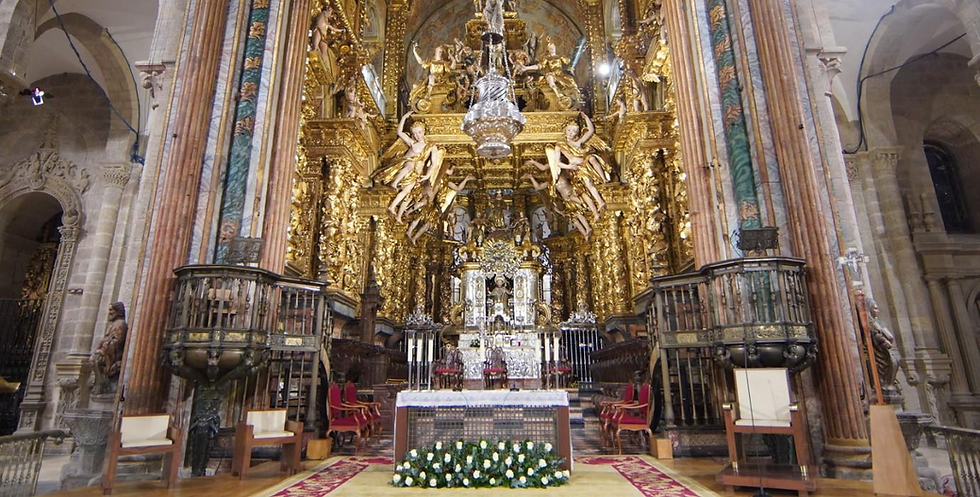
The final destination is the magnificent Santiago de Compostela Cathedral. After hundreds of miles, pilgrims enter the great square before the cathedral with emotions that are difficult to describe. Many weep with joy. Others kneel in thanksgiving.
Within the cathedral lies the traditional tomb of Saint James. Pilgrims come not merely to admire history but to pray before the Apostle who gave his life for Christ.
One of the cathedral's most famous traditions is the great Botafumeiro, an enormous thurible that swings high through the nave during certain liturgical celebrations. The rising incense symbolizes the prayers of God's people ascending to heaven.
Lessons for Every Christian

Not every Catholic will travel to Spain, yet every Christian is called to make the pilgrimage of faith.
The Camino reminds us that:
Life is a journey toward eternity.
We travel best when we carry fewer unnecessary burdens.
Prayer grows stronger through perseverance.
Fellow believers help us reach our destination.
Christ walks beside us, even when the road is steep.
Saint James left everything to follow Jesus. Pilgrims who walk in his footsteps are invited to renew that same decision each day.
A Pilgrimage of the Heart
The greatest miracle of Compostela is not simply the ancient cathedral or the beauty of northern Spain. It is the quiet transformation that God often works within the human heart.
Many pilgrims arrive seeking answers and leave with something even greater: a deeper trust in Divine Providence, a renewed love for the sacraments, and a stronger desire to live as faithful disciples of Christ.
Whether we walk hundreds of miles across Spain or simply strive each day to follow Christ faithfully in our homes, we are all pilgrims. Saint Paul reminds us,
"For we have not here a lasting city, but we seek one that is to come" (Hebrews 13:14).
May Saint James, who left his fishing nets to follow the Master and who sealed his witness with his blood, intercede for all who journey toward Christ. And may every step we take in this life bring us closer to our true Compostela: the eternal joy of heaven.
Bibliography
The Holy Bible, Acts 12; Matthew 4; Mark 1; Luke 9.
Jacobus de Voragine. The Golden Legend. Translated by William Granger Ryan. Princeton University Press, 1993.
Butler, Alban. The Lives of the Saints. Various editions.
Guéranger, Dom Prosper. The Liturgical Year. Vol. 9. Dublin: James Duffy, various editions.
Melczer, William. The Pilgrim's Guide to Santiago de Compostela. New York: Italica Press, 1993.
Davies, Horton, and Marie-Hélène Davies. Holy Days and Holidays: The Medieval Pilgrimage Tradition. Eerdmans, 1982.


Comments