


“I Believe in One, Holy, Catholic and Apostolic Church”
Fr. Scott Haynes
A Meditation on an Article of the Creed
Every Sunday, throughout the Catholic world, the faithful rise and make a remarkable profession of faith:
“I believe in one, holy, catholic and apostolic Church.”
We say these words immediately after professing faith in the Father, the Son, the Holy Ghost, the Incarnation, the Cross, the Resurrection, and the return of Christ in glory. The Church is not inserted into the Creed as an afterthought. Faith in the Church belongs within the great profession of what God has accomplished for our salvation.
And the words are strikingly definite. We do not profess belief merely in Christianity as an inspiring spiritual tradition, nor in a religious movement that began with Jesus and gradually assumed different forms as succeeding generations adapted His message to their circumstances. We profess belief in the Church: one, holy, catholic, and apostolic.
This conviction reaches back to Christ Himself.
“I Will Build My Church”
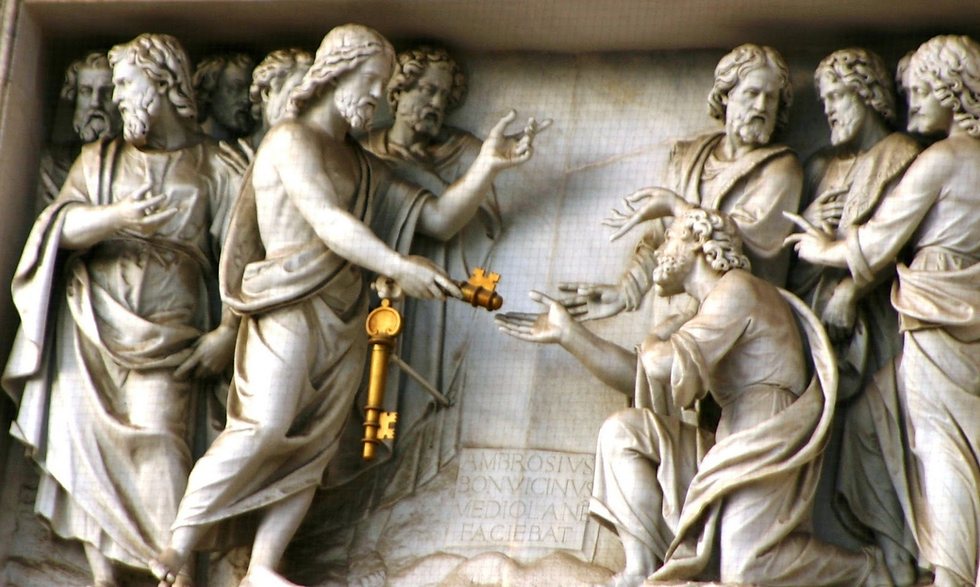
When Simon Peter confessed, “Thou art Christ, the Son of the living God,” our Lord answered:
“Thou art Peter; and upon this rock I will build my church, and the gates of hell shall not prevail against it” (Matthew 16:18).
The language is unmistakably concrete. Christ says, “my church.” He speaks of something He Himself will build. He gives Simon a new name, identifies him with the rock, gives him the keys of the kingdom, and confers authority to bind and loose (Matthew 16:18–19).
The same pattern continues throughout the Gospel. Jesus does not simply gather admirers around a message. He chooses twelve men from among His disciples (Luke 6:13), a number recalling the twelve tribes of Israel. He sends them to preach in His name. He gives them authority. He institutes the Eucharist and commands them,
“Do this for a commemoration of me” (Luke 22:19).
After His Resurrection He entrusts them with the forgiveness of sins (John 20:21–23). He commands Peter, “Feed my sheep” (John 21:17).
Finally, before ascending into heaven, He sends the Apostles into the entire world:
“Going therefore, teach ye all nations; baptizing them in the name of the Father, and of the Son, and of the Holy Ghost. Teaching them to observe all things whatsoever I have commanded you: and behold I am with you all days, even to the consummation of the world” (Matthew 28:19–20).
The command is universal, but so is the promise. Christ will remain with His Church “all days.”
The Church therefore does not simply remember Jesus. Jesus remains with His Church.
The Church Is His Body
Saint Paul takes us still deeper into the mystery. The Church is not merely an institution founded by Christ and then left behind when He ascended into heaven. She possesses a mysterious living union with Him.
“You are the body of Christ,” Saint Paul tells the Corinthians (1 Corinthians 12:27).
To the Ephesians he speaks of Christ as the Head of the Church, “which is His body” (Ephesians 1:22–23). This is more than metaphorical language for a group of people sharing similar religious convictions. Christ is the Head; Christians are members; the Holy Ghost gives life to the whole.
Pope Pius XII drew upon precisely this biblical language in Mystici Corporis Christi. He wrote that nothing is “more noble, more sublime, or more divine” as a description of the true Church than the expression “the Mystical Body of Christ.” He explicitly identified this Church as “the One, Holy, Catholic, Apostolic and Roman Church.”[1]
The Church is therefore not simply a society that happens to preserve the memory and teachings of its founder. Her relationship with Christ is organic and supernatural. The risen Christ is her Head.
The Bride of Christ
Sacred Scripture gives us another image that is, if anything, still more intimate.
Christ is the Bridegroom, and the Church is His Bride.
Saint Paul writes:
“Christ also loved the church, and delivered himself up for it: that He might sanctify it” (Ephesians 5:25–26).
He then compares Christian marriage with the union between Christ and His Church:
“This is a great sacrament; but I speak in Christ and in the church” (Ephesians 5:32).
The Second Vatican Council gathered these biblical images together beautifully. Lumen Gentium teaches that Christ loves the Church as His Bride while filling the Church, His Body, with His divine gifts. The Council also states plainly that
“Christ, the one Mediator, established and continually sustains here on earth His holy Church.”[2]
This distinction is important. The Church is certainly alive. She grows. She preaches in new languages, encounters new cultures, develops her disciplines, deepens her theological understanding, and applies the Gospel to circumstances that the Apostles never encountered.
But the Church does not create herself.
Christ established her.
The Fathers Knew This Church
One might object that this highly developed understanding of the Church arose only centuries after the Apostles. The earliest Christian writers tell a very different story.
Around the beginning of the second century, Saint Ignatius of Antioch was being taken under guard to Rome, where he would suffer martyrdom. In his Letter to the Smyrnaeans, he spoke naturally of bishops, priests, deacons, Baptism, and the Eucharist. He instructed Christians to remain united to their bishop and then wrote the famous words:
“Wherever Jesus Christ is, there is the Catholic Church.”[3]
This is extraordinary because of its date. We are not reading a medieval theologian. We are listening to a bishop from the generation immediately following the Apostles, and the expression “Catholic Church” already appears naturally in his description of Christian life.
Saint Cyprian of Carthage, writing in the third century, was equally emphatic about ecclesial unity. Pope Leo XIII later quoted his words:
“There is one God, and one Christ; and His Church is one and the faith is one.”
Cyprian compared the Church to a living body whose members cannot simply sever themselves from the body and continue as though nothing has happened.[4]
This is recognizably the world of the Creed: one Church, one faith, one body, one Christ.
One, Holy, Catholic and Apostolic
The four marks of the Church are therefore not ornamental adjectives.
The Church is one because her Lord is one, her faith is one, her Baptism is one, and her members belong to the one Body of Christ.
She is holy because Christ, her Head and Bridegroom, is holy and has given Himself for her sanctification.
She is catholic because Christ sent her to “all nations,” and her mission extends across every land, race, culture, and century.
She is apostolic because she did not invent herself after the Apostles disappeared. Her faith, sacraments, ministry, and mission descend from the commission Christ entrusted to the Apostles.
Pope Leo XIII emphasized precisely this point in his 1896 encyclical Satis Cognitum. He insisted that when considering the nature of the Church, the decisive question is what Christ Himself intended and actually established. The Pope wrote that Christ “instituted and formed the Church” and that its constitution belongs to what Christ Himself willed. He therefore rejected the notion that Christ founded several disconnected Christian communities, emphasizing instead the profession of the Creed: “I believe in one Church.”[5]
The First Vatican Council expressed the same conviction in Pastor Aeternus. Christ willed to establish a holy Church in which the faithful would be united in one faith and charity, and He intended pastors and teachers to remain within that Church until the end of the world. The Council particularly emphasized the permanent character of the Petrine office established by Christ.[6]
This is not a Church endlessly inventing herself. It is a Church receiving something from Christ and handing it on.
The Faith Is Received, Not Invented
This brings us to an essential distinction.
The Catholic Church certainly recognizes authentic development. Saint Vincent of Lérins famously distinguished genuine growth from alteration: Christian doctrine can mature and be understood more deeply, just as a human being grows from childhood into adulthood while remaining the same person.
The First Vatican Council subsequently articulated the principle with great precision. The doctrine revealed by God was not delivered to the Church as a philosophical theory that human intelligence could continually refashion. Rather, it was entrusted to the Church as a divine deposit, to be faithfully guarded and authentically interpreted.
Pope Saint Pius X later quoted this teaching in Pascendi Dominici Gregis, while also recalling the traditional formula that authentic growth must remain within the same dogma, the same meaning, and the same judgment.[7]
There can therefore be genuine development without mutation.
The oak may grow from the acorn, but the acorn does not develop into a rosebush.
The Church can deepen her understanding of what Christ revealed without transforming the faith into something essentially different from what Christ entrusted to the Apostles.
A Church That Belongs to Christ
This is why the language of Pope Leo XIII is so powerful. In Satis Cognitum he observes that Christ speaks of only one Church and calls it His own:
“I will build my church.”
The possessive matters.
His Church.
She belongs to Christ before she belongs to any century, civilization, nation, theological school, pope, bishop, priest, or generation of Catholics.
Pope Boniface VIII employed similarly forceful language in Unam Sanctam in 1302, professing “one holy catholic and apostolic Church” and describing her as one Mystical Body whose Head is Christ.[8]
Centuries later Pius XII spoke in virtually the same ecclesial language in Mystici Corporis Christi: the Church is the Mystical Body of Christ and Christ is her Head.
The continuity is striking.
Saint Ignatius speaks of the Catholic Church, while Saint Cyprian speaks of one Church and one faith. The Creed solemnly professes one, holy, catholic, and apostolic Church, and medieval papal teaching describes this same Church as one Mystical Body with Christ as its Head. Pope Leo XIII teaches that Christ Himself instituted and formed the Church, while the First Vatican Council speaks of Christ establishing His Church and willing her apostolic ministry to endure. Pope Pius XII identifies the Church as the Mystical Body of Christ, and the Second Vatican Council affirms that Christ established His Church and continually sustains her. Across the centuries, the language becomes more developed and theological questions are treated with increasing precision, yet the underlying reality remains unmistakably the same: Jesus Christ founded His Church.
Then Comes Lamentabili Sane
Against this immense background of Scripture, Fathers, councils, creeds, and papal teaching, we can better understand why a proposition condemned in 1907 was so serious.
In Lamentabili Sane Exitu, the Holy Office listed among the condemned propositions the assertion:
“Christ did not teach a determined body of doctrine applicable to all times and all men, but rather inaugurated a religious movement adapted or to be adapted to different times and places.”[9]
Read in isolation, the language might initially sound almost harmless. Christianity certainly spread as a movement across the Roman world. Missionaries certainly adapted their methods to different peoples. The Church has certainly expressed the same faith in different languages and cultures.
But that is not what the condemned proposition says.
Its crucial contrast is between Christ giving a determinate doctrine applicable to all ages and Christ merely inaugurating a religious movement whose content must subsequently be adapted to changing historical circumstances.
That understanding cannot be reconciled with the vision of the Church we have just traced.
Christ does not merely inspire a movement. He says,
“I will build my church.”
He does not merely leave behind a religious impulse. He commands the Apostles to teach the nations “all things whatsoever I have commanded you.”
He does not promise merely that His ideals will survive. He promises the Apostles,
“I am with you all days, even to the consummation of the world.”
The Apostles do not describe themselves as creative architects of a new religion. Saint Paul speaks of what he has received and delivered (1 Corinthians 11:23; 15:3).
The early Christians do not speak merely about a movement inspired by Jesus. Ignatius speaks of the Catholic Church.
The Creed does not say:
I believe in an evolving religious movement adapted to the needs of successive ages.
It says:
“I believe in one, holy, catholic and apostolic Church.”
That is a profoundly different claim.
Living Without Becoming Something Else
None of this requires us to imagine the Church as frozen in the first century.
A living Church encounters new questions. She confronts new heresies, develops theological terminology, establishes and reforms disciplines, founds religious orders, evangelizes new civilizations, adopts legitimate liturgical variations, makes use of new technologies, and discovers new ways of presenting ancient truths.
There is a legitimate sense in which the Church must know how to speak to every age. But speaking the apostolic faith to a new age is not the same thing as creating a new faith for every age. That distinction lies near the heart of the Catholic response to Modernism.
Pius X explained in Pascendi Dominici Gregis that the Modernist conception subjected dogma, Church, worship, Scripture, and even faith itself to an evolutionary process. Against this, he appealed to the Catholic understanding of revelation as a divine deposit entrusted to the Bride of Christ to be faithfully guarded and interpreted.[10]
The Church grows because she is alive. But she remains herself because she belongs to Christ.
“I Believe in One Church”
We therefore return to where we began.
At Mass the Catholic stands and says:
“I believe in one, holy, catholic and apostolic Church.”
Those words contain an entire ecclesiology.
I believe that Jesus Christ did something concrete in history.
I believe that He called Apostles.
I believe that He built His Church.
I believe that He made her His Body.
I believe that He loves her as His Bride.
I believe that He entrusted her with His Gospel and His sacraments.
I believe that the apostolic faith is something received and handed on, not something reconstructed whenever the spirit of an age changes.
And I believe His promise:
“Behold I am with you all days, even to the consummation of the world” (Matthew 28:20).
The Church must preach Christ in every age, to every people, in every language. Her methods may change, her disciplines may develop, and her understanding of the inexhaustible riches of revelation may deepen. Yet beneath all legitimate development stands a reality that no age created and no age possesses the authority to reinvent.
Jesus Christ founded His Church. She is His Mystical Body and His Bride. She received her faith from Him through the Apostles. And after twenty centuries she still rises to confess the faith that identifies her:
“I believe in one, holy, catholic and apostolic Church.”
Footnotes
¹ Pius XII, Mystici Corporis Christi (June 29, 1943), nos. 1, 13–14, Vatican.
² Second Vatican Council, Dogmatic Constitution Lumen Gentium (November 21, 1964), nos. 7–8.
³ Ignatius of Antioch, Letter to the Smyrnaeans 8, in Ante-Nicene Fathers, vol. 1, ed. Alexander Roberts and James Donaldson (Buffalo, NY: Christian Literature Publishing Co., 1885).
⁴ Cyprian of Carthage, On the Unity of the Catholic Church 23, quoted in Leo XIII, Satis Cognitum (June 29, 1896), no. 5.
⁵ Leo XIII, Satis Cognitum (June 29, 1896), nos. 3–6.
⁶ First Vatican Council, Dogmatic Constitution Pastor Aeternus (July 18, 1870), introduction and chap. 2.
⁷ Pius X, Pascendi Dominici Gregis (September 8, 1907), no. 28.
⁸ Boniface VIII, Unam Sanctam (November 18, 1302).
⁹ Sacred Congregation of the Holy Office, Lamentabili Sane Exitu (July 3, 1907), no. 59.
¹⁰ Pius X, Pascendi Dominici Gregis, nos. 26–28.


Comments