


Death Meets Life
Fr. Scott Haynes
A Meditation on Luke 7:11–16
Luke 7:11–16 is one of the most tender scenes in the Gospel, but the Fathers also saw in it a profound revelation of who Christ is. It is simultaneously a historical miracle, a revelation of His divine power over death, a sign of the future resurrection, and an image of the way Christ restores souls that have been spiritually deadened by sin.
Luke 7:11–16
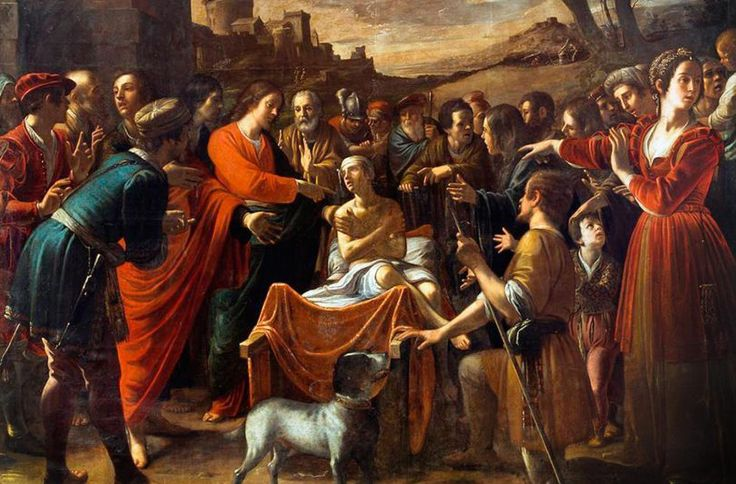
“And it came to pass afterwards, that he went into a city that is called Naim; and there went with him his disciples, and a great multitude. And when he came nigh to the gate of the city, behold a dead man was carried out, the only son of his mother; and she was a widow: and a great multitude of the city was with her. Whom when the Lord had seen, being moved with mercy towards her, he said to her: Weep not. And he came near and touched the bier. And they that carried it, stood still. And he said: Young man, I say to thee, arise. And he that was dead, sat up, and began to speak. And he gave him to his mother. And there came a fear on them all: and they glorified God, saying: A great prophet is risen up among us: and, God hath visited his people.”— Luke 7:11–16
Two Processions Meet at the Gate
Saint Luke constructs the scene almost as though two processions are moving toward one another. Jesus approaches Nain accompanied by His disciples and “a great multitude,” while coming out of the city is another multitude accompanying a widow who is burying her only son. One procession follows Christ, the source of life; the other follows a young man toward the grave. They meet at the city gate, and from the moment Christ enters the scene, death can proceed no farther.
Saint Cyril of Alexandria expressed this beautifully when he described the encounter by saying that the dead man was being taken to his tomb, “but there meets him the Life and Resurrection, even Christ.”¹
Cyril's choice of words is important. Jesus does not merely possess the ability to restore life. He is the Life who confronts death. What happens at Nain is therefore a small anticipation of the great victory that will occur through Christ's own Death and Resurrection, when death itself will be conquered. (Tertullian Project)
There is another detail that Saint Cyril considers important. No one asks Jesus to perform this miracle. Jairus begged Him to come to his daughter. Martha and Mary sent word concerning Lazarus. The centurion had appealed to Him regarding his servant. At Nain, however, the widow apparently asks for nothing, perhaps because she cannot imagine that anything can now be done. Cyril therefore observes that “no one summoned Him to restore the dead man to life, but He comes to do so of His own accord.”² (Tertullian Project)
This gives the passage a beautiful theological depth. Divine mercy moves first. The widow does not formulate a prayer, demonstrate extraordinary faith, or even approach Jesus. Christ sees her before she speaks to Him, knows the depth of her sorrow, and acts. Grace is already moving toward human misery before human misery has found the words with which to ask for grace.
“The Only Son of His Mother, and She Was a Widow”
Saint Luke could simply have said that a young man had died, but instead he carefully tells us that he was an only son and that his mother was a widow. Saint Gregory of Nyssa recognized how much sorrow Luke compresses into these few words. He writes that the Gospel “conveys much in few words,” because this widow has not merely lost a child; she has lost the person around whom the remainder of her earthly life had been gathered.³ (New Advent)
Her husband is already dead. Now her only son is dead. She has therefore lost both the person she loved and, in the society of that time, the son upon whom she might naturally have depended as she grew older. Saint Gregory dwells tenderly upon this tragedy, explaining that she could not look toward another child to take his place. Her bereavement seems humanly complete.
This explains the force of Luke's words:
“Whom when the Lord had seen, being moved with mercy towards her.”
Jesus first looks at the mother, not the corpse. Before Saint Luke reveals Christ's power, he reveals Christ's heart.
The miracle therefore begins with compassion.
The Fathers repeatedly noticed this order. The Venerable Bede points out that Christ is first moved by compassion for the mother and only afterward raises her son, so that His mercy may be an example for us while His power strengthens our faith. (e-Catholic 2000) Christ does not exercise divine omnipotence coldly. The One who commands death to surrender is also the One who notices a widow's tears.
“Weep Not”
At first these words could almost seem severe. How can Christ tell a mother walking beside the body of her only son not to weep?
Yet He does not tell her that her grief is foolish, nor does Christianity teach that sorrow at death is wrong. Christ Himself will weep at Lazarus's tomb. Here the command “Weep not” is different because Jesus knows what He is about to do. As Bede explains it, Christ is effectively telling her to cease mourning one as dead whom she is shortly going to see alive again. (e-Catholic 2000)
The words consequently point beyond the immediate miracle toward Christian hope in the resurrection. Saint Gregory of Nyssa saw Christ's raising of the dead as a series of demonstrations preparing the human mind to believe something still greater. The restoration of the young man at Nain is not merely an isolated wonder. It is evidence that the One speaking about resurrection truly possesses authority over death. Gregory writes that Christ's works prepare us to believe “far greater” things concerning the resurrection still to come.⁴ (New Advent)
This does not mean that Christians do not grieve. It means that Christian grief is not hopeless grief. The widow's tears belong to a world in which death appears to have the final word. Christ's presence announces that it does not.
“He Came Near and Touched the Bier”
This action fascinated Saint Cyril of Alexandria. Jesus could have raised the young man by His word alone, just as He had healed the centurion's servant without even entering his house. Yet here Christ deliberately approaches and touches the bier.
Cyril asks precisely this question: if the Word of God was sufficient to raise the dead, why did Jesus touch the bier? His answer is deeply Christological. Christ wants us to understand that His human body is the body of the divine Word and therefore becomes an instrument of divine, life-giving power. Cyril writes that “the holy body of Christ is effectual for the salvation of man.”⁵ (Tertullian Project)
This is an important defense of the Incarnation. Christ does not save us as though His humanity were merely a disguise concealing His divinity. The eternal Son truly assumed human flesh, and through that flesh He heals, touches, suffers, dies, rises, and communicates life. Cyril compares Christ's humanity to iron placed in fire: the iron becomes filled with the fire's energy without ceasing to be iron. In a somewhat analogous fashion, Christ's human nature belongs personally to the eternal Word and becomes the instrument through which the Word gives life. (Tertullian Project)
For Catholic theology, the passage therefore points naturally toward the sacramental character of Christianity. God chooses to communicate invisible grace through visible realities because the Son of God Himself entered the material world and made His human body the instrument of salvation.
“Young Man, I Say to Thee, Arise”
Here we arrive at the heart of the miracle. Jesus does not pray over the dead man.
This sharply distinguishes Him from the Old Testament prophets. Elijah prayed and stretched himself over the widow's dead son before the child revived (3 Kings 17:17–24). Elisha prayed and lay upon the Shunammite woman's son (4 Kings 4:32–37). Jesus simply speaks:
“Young man, I say to thee, arise.”
The authority resides in Him.
The crowd correctly recognizes a resemblance to the prophets, which explains its cry, “A great prophet is risen up among us.” Nevertheless, the reader of the Gospel is being led farther than the crowd has yet understood. Christ certainly fulfills and surpasses the prophetic signs of Elijah and Elisha, but He does not merely ask God to raise the dead. He commands the dead Himself.
Saint Cyril therefore describes the words as a “godlike word.” The command and its fulfillment are virtually simultaneous: Christ speaks, and the dead man obeys.⁶ (Tertullian Project)
There is almost an astonishing simplicity about it. Death has no argument with Christ and offers no resistance. The dead man hears the voice of the Son of God and rises.
This anticipates Christ's teaching in Saint John's Gospel:
“The hour cometh, wherein all that are in the graves shall hear the voice of the Son of God. And they that have done good things, shall come forth unto the resurrection of life” (John 5:28–29).
Nain is therefore a preview in miniature of the resurrection of the dead.
“He That Was Dead Sat Up, and Began to Speak”
Saint Luke adds two details that demonstrate the completeness of the miracle. The young man sits up, and then he begins speaking. Saint Cyril explicitly notices this. A corpse might conceivably have been propped upright, but a dead man cannot begin speaking. Luke records speech as evidence that life has genuinely returned.⁷ (Tertullian Project)
There is also an important distinction between this young man's restoration and Christ's Resurrection. The young man of Nain has been returned to ordinary mortal life. He will eventually die again. Christ's Resurrection is of another order: He rises never to die again.
For this reason Saint Gregory of Nyssa considers miracles such as Nain pledges or anticipations of the universal resurrection rather than the resurrection in its final form. Christ demonstrates on individual persons what He possesses the power eventually to accomplish for the whole human race. (New Advent)
“And He Gave Him to His Mother”
This quiet sentence may be one of the most beautiful in the entire passage.
Jesus does not merely demonstrate His power and then depart. He restores a relationship. He returns a son to his mother.
The wording deliberately recalls Elijah's raising of the widow's son at Sarepta, where the prophet “delivered him to his mother” (3 Kings 17:23). Saint Luke's language invites the reader to recognize Jesus as fulfilling the prophetic pattern associated with Elijah, which helps explain the crowd's conclusion that “a great prophet is risen up among us.”
Yet again, Christ is greater than the pattern. Elijah had cried to God and prayed for the child's life. Jesus commands life to return.
The miracle therefore reveals something about salvation itself. Christ does not simply rescue isolated individuals. Sin and death tear apart communion, families, friendships, and ultimately the communion between man and God. Christ's work restores what death has separated. At Nain, the first visible consequence of restored life is restored communion:
“He gave him to his mother.”
The Young Man as the Soul Dead in Sin
The Fathers also read the miracle spiritually, without denying for a moment that the young man had actually died and was actually raised.
Saint Augustine compares the three famous Gospel raisings: Jairus's daughter, the young man of Nain, and Lazarus. He sees in them three different stages of spiritual death.
Jairus's daughter dies inside the house. Augustine interprets this as sin that has been conceived inwardly but has not yet been carried into external action. The young man of Nain has already been carried outside the city gate, which Augustine interprets as sin that has passed from inward consent into outward action. Lazarus has gone even farther: he has been dead four days and lies in the tomb, representing the person whose repeated sins have hardened into habit. Yet Christ raises all three.
Augustine's conclusion is extraordinarily hopeful. Speaking specifically of the young man at Nain, he says that even after the sinful intention has become an outward deed, the sinner still has One who can say,
“Young man, I say unto thee, Arise.”⁸ (New Advent)
This is one of the most important spiritual lessons of the passage. There is a point beyond which human beings may think someone spiritually lost, but there is no stage of spiritual death from which Christ lacks the power to raise a repentant soul.
Augustine goes still farther by comparing the widow with Mother Church. The bodily resurrection at Nain becomes an image of what happens whenever a sinner is restored to supernatural life. He writes:
“The widowed mother rejoiced at the raising again of that young man; of men raised again in spirit day by day does Mother Church rejoice.”⁹ (New Advent)
Saint Ambrose develops the same image. The grieving widow becomes an image of the Church mourning over her spiritually dead children. He therefore encourages the sinner who can scarcely pray for himself to allow Mother Church to pray and weep for him. Ambrose sees the Church's tears as the prayers, penances, intercessions, and maternal solicitude by which she continually pleads that her children be brought back from spiritual death.¹⁰ (Catena Bible & Commentaries)
This makes the scene at Nain particularly powerful as an image of conversion. Christ stops a funeral procession that appears already committed to its destination. Everything seems decided. The young man is dead; the burial has begun; the mourners are moving toward the grave. Yet Christ steps into the road.
That is precisely what grace can do in the life of a sinner.
“God Hath Visited His People”
The crowd's final words are more profound than they themselves may fully understand:
“God hath visited his people.”
In biblical language, God's “visitation” means that God has drawn near in order to act decisively for His people. Saint Luke has already used similar language in the Benedictus, where Zachary praises God because “he hath visited and wrought the redemption of his people” (Luke 1:68).
At Nain this visitation becomes visible. God has come near to human sorrow. He has approached a widow, touched the bier carrying her son, stopped the procession toward the grave, and commanded the dead to live.
Yet the full significance of the expression will become clear only after Easter. The young man of Nain is raised because Christ possesses authority over death, but Christ Himself will enter death, overthrow it from within, and rise in a body that can never die again. Saint Cyril therefore regarded the people whom Christ raised during His earthly ministry as “a pledge of the hope prepared for us of a resurrection of the dead.”¹¹ (Tertullian Project)
Luke 7:11–16 is consequently much more than a story about Jesus consoling one grieving mother. It reveals the whole direction of the Gospel. Humanity is moving toward the grave, wounded by sin and unable to restore life to itself. Christ comes toward us without waiting to be summoned, is moved by mercy, touches our mortality with His own life-giving humanity, speaks a word that death cannot resist, and gives back what death had taken away.
At the gate of Nain, Life meets death, and death is forced to stop.
Footnotes
¹ Saint Cyril of Alexandria, Commentary upon the Gospel according to St. Luke, Sermon 36, trans. R. Payne Smith (Oxford: Oxford University Press, 1859), on Luke 7:11–16. Online text at Tertullian.org
² Cyril of Alexandria, Commentary upon the Gospel according to St. Luke, Sermon 36. Online text
³ Saint Gregory of Nyssa, On the Making of Man, chap. 25, in Nicene and Post-Nicene Fathers, 2nd ser., vol. 5, ed. Philip Schaff and Henry Wace. New Advent text
⁴ Gregory of Nyssa, On the Making of Man, chap. 25. New Advent text
⁵ Cyril of Alexandria, Commentary upon the Gospel according to St. Luke, Sermon 36. Online text
⁶ Cyril of Alexandria, Commentary upon the Gospel according to St. Luke, Sermon 36.
⁷ Cyril of Alexandria, Commentary upon the Gospel according to St. Luke, Sermon 36.
⁸ Saint Augustine of Hippo, “Sermon 48 on the New Testament,” sec. 14, on the three persons raised from the dead by Christ. New Advent text
⁹ Augustine of Hippo, “Sermon 48 on the New Testament,” sec. 2. New Advent text
¹⁰ Saint Ambrose of Milan, Exposition of the Gospel of Luke, 5.89–92, as preserved in Saint Thomas Aquinas, Catena Aurea, commentary on Luke 7:11–17. Catena Aurea, Luke 7
¹¹ Cyril of Alexandria, Commentary upon the Gospel according to St. Luke, Sermon 36. Online text


Comments