


Our Armour is Christ
Fr. Scott Haynes
A Meditation on Ephesians 6:10–17
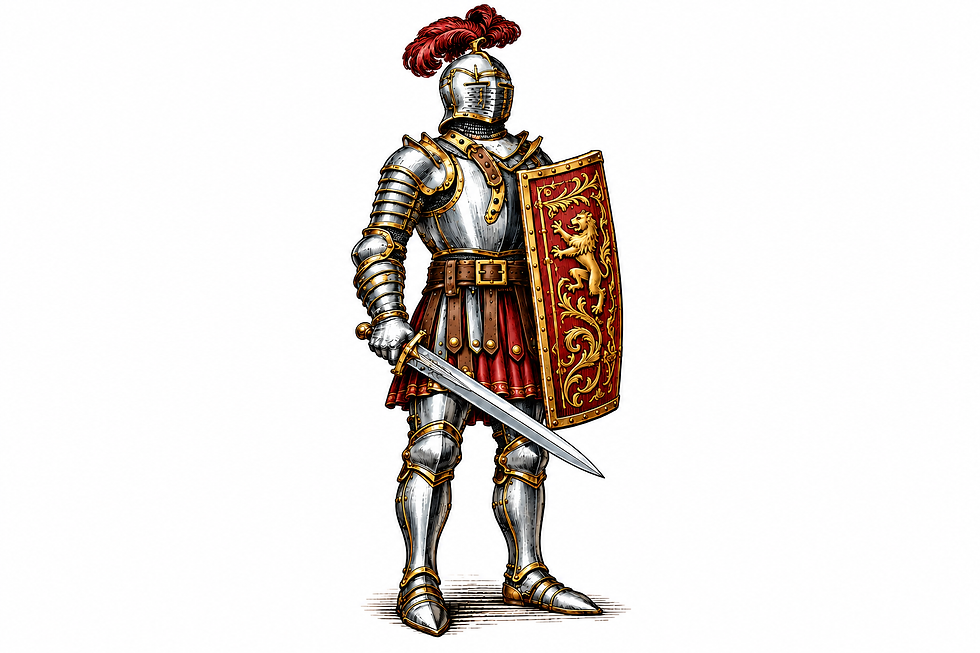
Finally, brethren, be strengthened in the Lord, and in the might of his power. Put you on the armour of God, that you may be able to stand against the deceits of the devil. For our wrestling is not against flesh and blood; but against principalities and powers, against the rulers of the world of this darkness, against the spirits of wickedness in the high places. Therefore take unto you the armour of God, that you may be able to resist in the evil day, and to stand in all things perfect. Stand therefore, having your loins girt about with truth, and having on the breastplate of justice, and your feet shod with the preparation of the gospel of peace: in all things taking the shield of faith, wherewith you may be able to extinguish all the fiery darts of the most wicked one. And take unto you the helmet of salvation, and the sword of the Spirit (which is the word of God).

In Ephesians 6:10–17, Saint Paul describes a Christian clothed for battle, yet every piece of armor belongs to the spiritual life: truth, justice, peace, faith, salvation, and the word of God. The Fathers explain this passage as a call to steadfast holiness, sustained by Christ. Saint Jerome expresses its center in five words:
“But our armour is Christ.”¹
The armor cannot be separated from the Savior who gives it.
Paul begins by directing us to strength in the Lord. Saint John Chrysostom understands this as dependence upon God’s assistance, especially when Christian duties seem overwhelming. He also observes that the devil works through deception, making vigilance necessary even after a victory over temptation. Yesterday’s faithfulness does not remove today’s need for grace.²
The belt of truth: an undivided life. Chrysostom explains that a soldier’s belt gathers loose clothing so that he can move freely; spiritually, truth gathers a scattered soul and makes it ready for obedience. His instruction is direct: “Whether it be an opinion, let us seek the truth, or whether it be a line of life, let us seek the true one.”³ Sound belief and honest conduct belong together. Applied to our daily lives, this means rejecting both false teaching and the convenient excuses by which we conceal our own faults.
The breastplate of justice: virtue protecting the heart. Chrysostom interprets righteousness here as “a life of universal virtue.”⁴ The breastplate represents goodness extending throughout one’s conduct. A practical examination of this armor asks whether our religious observance is accompanied by honesty, chastity, patience, and mercy. We should not carefully guard one part of our lives while willingly exposing another to sin.
The footwear of the Gospel of peace: readiness to walk with God. Chrysostom connects this image with conduct worthy of the Gospel and reconciliation with God. Resisting the devil serves that peace: “if we are at war with the devil, we are at peace with God.”⁵ For us, this suggests a searching test: does our supposed spiritual zeal produce greater faithfulness and charity, or merely make us more quarrelsome?
The shield of faith: protection when temptation strikes. In Saint John Cassian’s account of Abbot Serenus’s teaching, faith extinguishes the fiery darts of lust through remembrance of judgment and belief in the heavenly kingdom.⁶ Temptation narrows our attention to an immediate pleasure; faith restores the larger horizon of eternity. A useful response to temptation is therefore to remember whose we are, what God promises, and where our choices lead.
The helmet of salvation: hope guarding fidelity to Christ. Cassian reads this image alongside the helmet of hope in 1 Thessalonians 5:8. Hope in the good things to come protects fidelity to Christ during temptation and persecution.⁷ The practical lesson is especially consoling when struggle becomes prolonged: present suffering must not be allowed to determine our judgment of God’s promises.
The sword of the Spirit: God’s word searching our own hearts. Cassian explains that this sword cuts away what is carnal and earthly within us.⁸ Scripture therefore calls its reader to conversion. Before using a biblical passage to correct someone else, we can ask what it exposes in our own desires, habits, and intentions.
Saint Cyprian gives these images particular force when writing to Christians threatened with persecution. He applies the helmet to the guarding of their senses and their confession of Christ, praying that “the conquering tongue may confess Christ its Lord.” He also connects their resistance to idolatry with remembrance of the Eucharist they have received.⁹ Here spiritual armor becomes visible in a Christian who refuses to surrender his baptismal allegiance, even under pressure. For our own examination, the question is concrete: when fidelity becomes costly, do my words and actions still confess the Lord?
Footnotes
Jerome, Letter 112 to Augustine, chap. 1, sec. 2, numbered Letter 75 in Augustine’s correspondence, trans. J. G. Cunningham, in Nicene and Post-Nicene Fathers, 1st ser., vol. 1, ed. Philip Schaff (Buffalo, NY: Christian Literature Publishing Co., 1887), revised for New Advent, https://www.newadvent.org/fathers/1102075.htm.
John Chrysostom, Homilies on Ephesians, homily 22, comments on Ephesians 6:10–13, trans. Gross Alexander, in Nicene and Post-Nicene Fathers, 1st ser., vol. 13, ed. Philip Schaff (Buffalo, NY: Christian Literature Publishing Co., 1889), revised for New Advent, https://www.newadvent.org/fathers/230122.htm.
Chrysostom, Homilies on Ephesians, homily 23, comments on Ephesians 6:14, https://www.newadvent.org/fathers/230123.htm.
Chrysostom, Homilies on Ephesians, homily 24, comments on Ephesians 6:14, https://www.newadvent.org/fathers/230124.htm.
Chrysostom, Homilies on Ephesians, homily 24, comments on Ephesians 6:15, https://www.newadvent.org/fathers/230124.htm.
John Cassian, Conferences, 7.5, trans. C. S. Gibson, in Nicene and Post-Nicene Fathers, 2nd ser., vol. 11, ed. Philip Schaff and Henry Wace (Buffalo, NY: Christian Literature Publishing Co., 1894), revised for New Advent, https://www.newadvent.org/fathers/350807.htm.
Cassian, Conferences, 7.5, discussion of the helmet of salvation, https://www.newadvent.org/fathers/350807.htm.
Cassian, Conferences, 7.5, discussion of the sword of the Spirit, https://www.newadvent.org/fathers/350807.htm.
Cyprian of Carthage, “To the People of Thibaris, Exhorting to Martyrdom,” Epistle 55, sec. 9, trans. Robert Ernest Wallis, in Ante-Nicene Fathers, vol. 5, ed. Alexander Roberts, James Donaldson, and A. Cleveland Coxe (Buffalo, NY: Christian Literature Publishing Co., 1886), revised for New Advent, https://www.newadvent.org/fathers/050655.htm.


Comments