


The Seven Holy Founders of the Servites
- Fr. Scott Haynes
- Jul 10
- 7 min read
Fr. Scott Haynes
Most religious orders begin with one great soul. St. Benedict went into the cave of Subiaco, and from that hidden solitude came the Benedictines. St. Francis of Assisi stripped himself of wealth before the bishop of Assisi, and from his poverty came the Franciscans. St. Dominic saw the danger of heresy and ignorance, and from his zeal came the Dominicans.
But the Order of Servants of Mary began in a different way. It began with seven men.
Seven friends. Seven businessmen. Seven men of Florence. Seven men who had money, influence, reputation, homes, families, prospects, and a respected place in society.
And one day, they walked away.
Try to imagine it. Imagine seven of the most successful Catholic businessmen in a great American city suddenly deciding that the world had too much of their heart. Imagine them selling what they had, providing for those dependent upon them, giving generously to the poor, putting on a simple habit, and leaving the noise of the city for prayer, penance, and the service of Our Lady.
People would talk. Some would admire them. Others would mock them. Their friends might say, “Have they lost their minds?” Their business associates might say,
“What a waste.”
Their families might ask,
“Why so extreme?”
But the saints often look extreme to a lukewarm age.
These seven men lived in Florence in the thirteenth century. It was a beautiful city, wealthy, artistic, active, and proud. Florence was filled with commerce, fine cloth, political ambition, family rivalries, and public devotion. Churches stood in the city, bells rang, processions moved through the streets, and yet many hearts had grown cold. Religion was present, but often without conversion. Prosperity had not made men grateful. It had made many restless, divided, and worldly.
The city was torn by factions. Families struggled for power. Heresies disturbed the faithful. Luxury increased. Sin became familiar. God was honored with the lips while ignored in the conduct of life.
Does that sound so far from our own time?
We also live in an age of wealth and distraction. We have comfort, speed, entertainment, communication, and endless noise. But how many souls are lonely? How many families are broken? How many children are confused? How many sins are defended as rights? How many things that cry out to Heaven are committed openly, without shame?
The blood of Abel cried from the earth:
“The voice of thy brother’s blood crieth to me from the earth” (Genesis 4:10).
The sin of Sodom cried out before God (Genesis 18:20). The oppression of the widow and orphan cried out before Him (Exodus 22:23). The wages kept back from laborers cried out to the Lord of hosts (James 5:4).
The Seven Holy Founders saw the wounds of their city. But notice what they did. They did not merely complain about Florence. They did not simply denounce the age. They did not stand at a distance and say,
“The world is wicked.”
They converted.
That is where reparation begins. Not with anger at other people’s sins, but with sorrow for sin itself. Not with pride that says, “I am not like them,” but with humility that says,
“Lord, have mercy on us.”
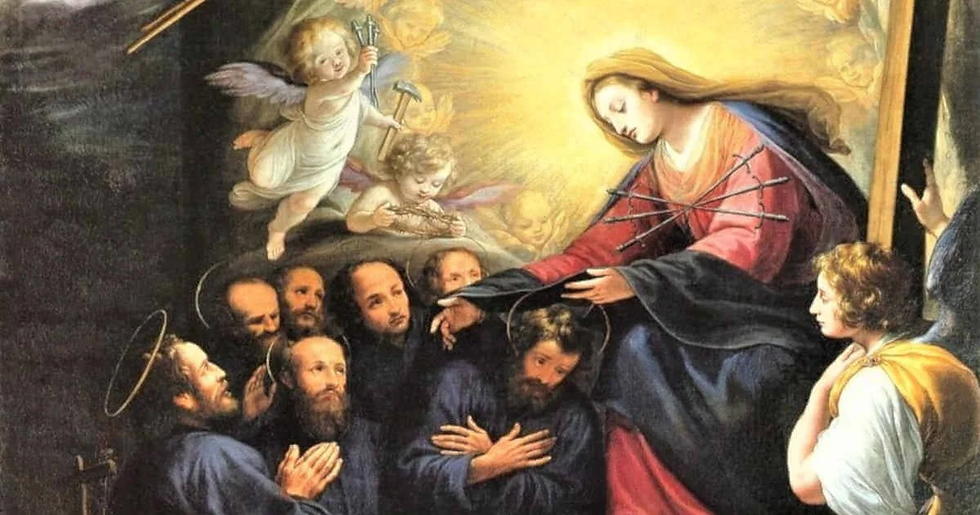
These seven men were members of a Marian confraternity known as the Laudesi, the Praisers of Mary. They gathered to honor the Mother of God, to sing her praises, and to seek her intercession. According to the ancient tradition of the order, on the Feast of the Assumption in 1233, the Blessed Virgin Mary appeared to them and called them to leave the world more completely and give themselves to God.
This is a powerful detail. The feast was the Assumption. Mary, already taken body and soul into Heaven, appeared to men still living in the dust and struggle of this world. She showed them the direction of life. Not downward into pleasure. Not sideways into ambition. Upward. Heavenward. Toward Christ.
They obeyed.
Their names deserve to be remembered: St. Bonfilius Monaldi, St. Alexis Falconieri, St. Manettus dell’Antella, St. Amadeus Amidei, St. Hugh Uguccioni, St. Sostene Sostegni, and St. Buonagiunta Manetti.
They withdrew first to a place outside Florence, and later to Monte Senario, a mountain north of the city. There, in prayer and poverty, they laid the foundation of the Order of Servants of Mary, the Servites.
They took the Rule of St. Augustine. They wore a black habit, which later tradition associated with the mourning of Our Lady at the foot of the Cross. Their name said everything: Servants of Mary.
Not masters. Not celebrities. Not reformers seeking applause. Servants.
That word is important. The world says,
“Make a name for yourself.”
Mary says,
“Behold the handmaid of the Lord.”
The world says,
“Climb.”
Mary says,
“Stand by the Cross.”
The world says,
“Take.”
Mary says,
“Receive God, and then give yourself away.”
The Seven Holy Founders understood that true devotion to Mary always leads to Christ. At Cana, she said,
“Whatsoever he shall say to you, do ye” (John 2:5).
At Calvary, she stood beneath the Cross, silent, faithful, pierced in soul. And from the Cross, Our Lord said to St. John,
“Behold thy mother” (John 19:27).
The Servites took those words seriously. They received Mary as Mother. But they received her especially as Mother of Sorrows.
The seven sorrows of Mary are not sentimental images. They are the path by which Our Lady followed her Son: the prophecy of St. Simeon, the flight into Egypt, the loss of the Child Jesus in the Temple, the meeting on the way to Calvary, the Crucifixion, the taking down of the Body of Jesus, and His burial.
To meditate on Mary’s sorrows is to learn how sin wounds love. It is to see what our redemption cost. It is to understand that at the center of history stands not comfort, not power, not human success, but the Cross of Jesus Christ.
The Seven Holy Founders were not escaping the world because they hated mankind. They withdrew so they could love mankind rightly. They went to the mountain not to abandon sinners, but to intercede for them. Their silence became a sermon. Their poverty became a rebuke to greed. Their penance became reparation. Their fraternity became a sign of peace in a divided city.
And God blessed them.
Tradition tells us that Our Lady confirmed their vocation and showed them the habit they were to wear. The order grew. Men came to join them. The hidden life on Monte Senario became a flame for the Church. From that mountain came not only a religious order, but a stream of Marian devotion that would console countless souls. Later Servite saints would include St. Philip Benizi, St. Juliana Falconieri, and St. Peregrine, the beloved patron of those suffering from cancer.
See how God works. Seven men give up their businesses, and centuries later the sick are still comforted. Seven men leave Florence, and devotion to Our Lady of Sorrows spreads through the Church. Seven men choose obscurity, and their names are placed on the altars of God.
This is the mystery of sacrifice. What we keep for ourselves dies with us. What we give to God lives.
One of the most beautiful things about the Seven Holy Founders is that they became saints together. We are used to thinking of holiness as an individual story. One saint, one conversion, one heroic life. But here we see holy friendship. Seven men helped one another become saints.
That is a lesson we desperately need.
Bad friendships pull souls downward. Worldly friendships excuse sin, laugh at purity, mock prayer, and make cowardice seem normal. But holy friendships lift the soul. A holy friend helps you remember Heaven. A holy friend does not flatter your weakness. A holy friend says,
“Let us pray. Let us do penance. Let us serve Our Lady. Let us go to Christ.”
Who are the people helping us become saints? And whom are we helping?
The Seven Holy Founders also teach us that reparation is not optional in a sinful age. We cannot look at the world’s sins and remain spiritually comfortable. Abortion, impurity, attacks on marriage, confusion among the young, neglect of the poor, cruelty, greed, blasphemy, and contempt for God all call for Catholics who will pray, sacrifice, and repair.
But reparation must begin close to home. It begins with Sunday Mass kept holy. It begins with confession. It begins with the Rosary. It begins with custody of the eyes, forgiveness in the family, generosity to the poor, reverence in church, fasting, and the courage to be different.
Not everyone is called to leave home for Monte Senario. But every Catholic needs some mountain of prayer. Every Catholic needs some place where the noise of the world grows quiet and the voice of God can be heard.
For some, that mountain is a daily Rosary before dawn. For others, it is a weekly Holy Hour. For others, it is kneeling beside the bed at night when the body is tired but the soul knows it must speak to God. For others, it is giving up a pleasure, turning away from a screen, making a good confession, or choosing silence instead of gossip.
Our Lady is still looking for servants.
She does not need admirers only. She has many people who admire her beauty, her tenderness, her purity, her motherhood. But she is looking for servants, souls who will stand with her beneath the Cross, who will console her Sorrowful Heart, who will pray for sinners, and who will say with their lives: “I belong to Christ.”
The Seven Holy Founders heard that call and answered it. They were wealthy, but they became poor. They were honored, but they became humble. They were busy in the world, but they became men of prayer. They lived in a divided city, but they became brothers. They saw sin, but instead of despairing, they offered themselves in reparation.
That is the lesson for us.
Do not say, “The world is too dark.” Light a candle by becoming holy.
Do not say, “The Church has too many problems.” Become faithful.
Do not say, “My family is too wounded.” Begin to pray and forgive.
Do not say, “My city is too far gone.” Make reparation.
Do not say, “I am only one person.” The Servite Order began with seven men who decided to belong entirely to God.
And the Mother of Sorrows was with them.
May she be with us also. May she teach us to mourn sin without bitterness, to fight evil without hatred, to love the Cross without fear, and to serve Christ with generous hearts.
Our Lady of Sorrows, pray for us.
Seven Holy Founders of the Servite Order, pray for us.
Amen.


Comments