


The Ocean of the Trinity
Fr. Scott Haynes

At Confirmation in one parish, the archbishop asked the children for a definition of the Holy Trinity. A girl answered very softly,
“The Holy Trinity is three Persons in one God.”
The old archbishop, who was almost deaf, replied,
“I didn’t understand what you said.”
The young little theologian now stood and said loudly,
“You are not supposed to. The Trinity is a mystery.”
That child had learned something many adults forget. A mystery is not something unreal. It is something too great to be exhausted. The ocean is real, though a child cannot hold it in his hands. The sun is real, though the eye cannot stare at it without being overwhelmed. So too, the Most Holy Trinity is not a puzzle to be solved, but an infinite ocean of divine life to be adored.
From ancient times, man has lifted his mind toward heaven and wondered about the inner life of God. The soul reaches upward, like a child stretching out his hand toward the sky, but it cannot grasp heaven by its own strength. With King David we pray:
“Lord, bow down thy heavens and descend” (Psalm 143:5).
We ask God to come down to us, to reveal Himself, and to touch us with His light.
And this is exactly what God has done.
The mystery of the Trinity is not something man discovered by cleverness. It is something God revealed by mercy. In the Incarnation, the Son of God descended from heaven, took our human nature, walked among us, spoke with a human voice, loved with a human heart, and revealed to us the Father, the Son, and the Holy Ghost.
This feast of the Most Holy Trinity was established in twelfth-century England under Saint Thomas Becket, Archbishop of Canterbury, and later came to be observed by the universal Church. Yet the faith it celebrates is as ancient as Christianity itself. We are baptized in the name of the Father, and of the Son, and of the Holy Ghost. We are absolved in that same holy name. We begin and end our prayers beneath the same sacred sign.
With the Sign of the Cross, we are wrapped in the love of the Father, and of the Son, and of the Holy Ghost. By making the Sign of the Cross, we bring God into our minds first. Then we bring the Trinity down to our hearts. And, with our hearts filled with compassion, we move the Trinity across our bodies to our shoulders and arms, so that we may better carry the cross we have been given.
There is an old story told about Saint Augustine. He was walking along the seashore while pondering the mystery of the Trinity. Before him stretched the vast ocean, glittering beneath the sun. As he walked, he noticed a little child running back and forth between the sea and a small hole in the sand. The child carried water in a shell, poured it into the hole, then ran back for more.
Augustine asked,
“My child, what are you doing?”
The child replied,
“I am trying to put the whole ocean into this little hole.”
Augustine smiled gently.
“My child, you cannot fit this great ocean into that tiny hole.”
Then the child answered,
“And you cannot fit the mystery of the Trinity into your mind.”
Then, according to the story, the child disappeared.
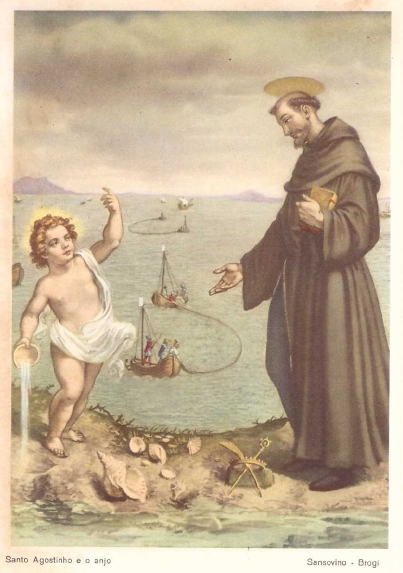
Whether the child was an angel or a heavenly messenger, the lesson remains true. The mystery of God is greater than the mind of man. We cannot pour the ocean of the Trinity into the little hole of our intellect. But that does not mean we know nothing. A child cannot contain the ocean, but he can touch it. He can kneel beside it. He can be refreshed by its waves.
So too, we cannot comprehend the Trinity fully, but we can know Him truly. We know that God is one. We know that in the one God there are three divine Persons: the Father, the Son, and the Holy Ghost. We know that God is not solitary loneliness, but eternal communion. Before creation, before the angels, before the stars, God is love.
Saint Augustine gives us a beautiful glimpse into this mystery: the Father is the Lover, the Son is the Beloved, and the Holy Ghost is the Love proceeding from the Father and the Son. This does not explain away the mystery. It invites us to adore.
If God is eternal love, then creation is not an accident. We were made by love, for love, and in the image of love. God did not create us because He was lonely. He created us because His goodness overflows. He did not redeem us because we were worthy. He redeemed us because His mercy is infinite.
And the Trinity is not only above us in heaven. The Trinity desires to dwell within us. Our Lord said, “If any one love me, he will keep my word, and my Father will love him, and we will come to him, and will make our abode with him” (John 14:23). The soul in the state of grace is not empty. It is a living temple. It is a sanctuary. It is a dwelling place of God.
Blessed Josepha Hendrina Stenmanns expressed this beautifully when she said:
“Make a tabernacle in your heart where the Holy Triune God constantly dwells.”¹
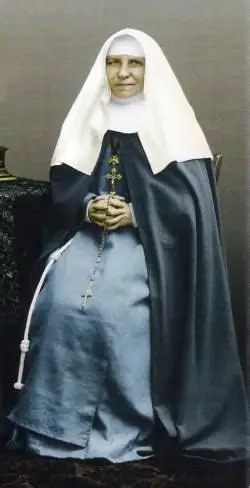
Blessed Josepha Hendrina Stenmanns
That is the invitation of Trinity Sunday. God does not wish merely to be admired from afar. He wishes to dwell within us. The Father creates and sustains us. The Son redeems and nourishes us. The Holy Ghost sanctifies and consoles us. When the soul lives in grace, heaven has already begun quietly within it.
This is why sin is so tragic. It forgets the God who dwells within. It drives charity from the heart. It turns the temple into a marketplace. But grace restores the soul, confession cleanses it, prayer opens it, and Holy Communion fills it with divine life.
So let us not treat the Trinity as a distant doctrine meant only for books. The Trinity is the life into which we were baptized. The Trinity is the name by which we are blessed. The Trinity is the love that surrounds us, sustains us, forgives us, and calls us home.
Make the Sign of the Cross slowly. Make it when you wake. Make it before meals. Make it when temptation comes. Make it when anxiety rises. Make it before work, before travel, before sleep. Let it remind you who you are and whose you are.
Saint Gaudentius gives this beautiful counsel: “Let the sign of the cross be continually made on the heart, on the mouth, on the forehead, at table, at the bath, in bed, coming in and going out, in joy and sadness, sitting, standing, speaking, walking—in short, in all our actions.”

Saint Gaudentius
On Trinity Sunday, the Church does not ask us to solve God. She asks us to adore Him.
We stand before the ocean. We hold our little shell. We know our minds are small and God is infinite. But we are not discouraged. The ocean is not less beautiful because it is deep. God is not less lovable because He is incomprehensible.
So let us leave this feast with humility, wonder, and love. Let us make our hearts a tabernacle for the Father, and the Son, and the Holy Ghost. Let us live under the Sign of the Cross. And when we feel small before the mystery of God, let us remember: we cannot contain the ocean, but we can be touched by its waves.
In the name of the Father, and of the Son, and of the Holy Ghost. Amen.



Comments